
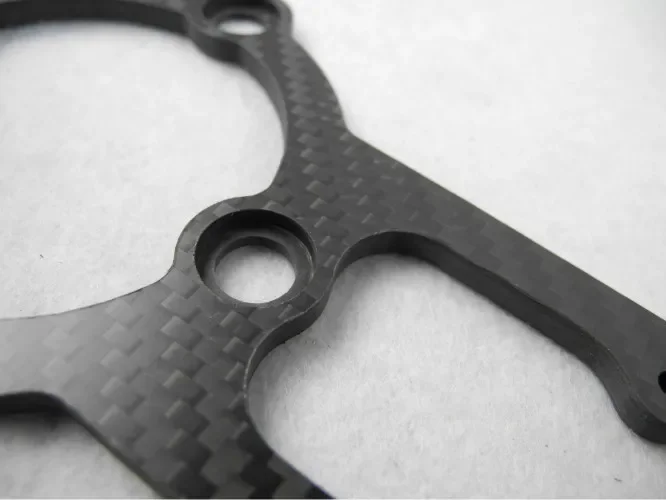
Composites in Manufacturing: Design, Performance, and Machining Advantages
Composite materials such as G10, carbon fiber, and fiberglass are widely used in CNC machining for their exceptional strength-to-weight ratios, corrosion resistance, and electrical insulation properties. Unlike metals, composites are engineered materials made by combining fibers with resins to achieve specific performance characteristics. They are commonly used in aerospace, electronics, medical, marine, energy, and industrial applications where lightweight strength and durability are critical.
Another key advantage of composites is their ability to perform in harsh environments. Composites do not rust, resist many chemicals, and maintain dimensional stability across temperature changes. While they can be more challenging to machine than metals, their performance benefits often make them the best choice for specialized applications where weight reduction, insulation, or corrosion resistance is required.
Common Composite Types and Their Uses
Each composite material offers unique advantages depending on fiber type and resin system. Choosing the correct composite ensures the part meets structural, electrical, and environmental requirements.
G10 (fiberglass laminate) is known for its high strength, excellent electrical insulation, and dimensional stability. It is commonly used for electrical components, structural spacers, insulators, and industrial fixtures. Carbon fiber offers an exceptional strength-to-weight ratio and high stiffness, making it ideal for aerospace components, performance equipment, and lightweight structural parts. Fiberglass provides good strength, corrosion resistance, and cost efficiency, often used in panels, enclosures, and structural components where extreme performance is not required.
Designing Parts with Composites
Designing parts with composites requires an understanding of directional strength and material behavior. Unlike metals, composites are often strongest along the direction of the fibers, so load paths must be carefully considered. Designers can leverage this property to create lightweight parts that are exceptionally strong in their intended orientation.
From a manufacturing standpoint, composite part design should minimize sharp corners and thin features that can lead to delamination or chipping. Proper support, generous radii, and realistic tolerances help ensure consistent machining results. Designers should also account for dust control and finishing requirements, as composite machining produces abrasive fibers.
Machining Composites
Machining composites presents unique challenges due to their abrasive nature and layered construction. Specialized tooling, controlled cutting parameters, and proper dust extraction are essential to maintain tool life and part quality. Unlike metals, composites do not deform under heat, but they can chip or delaminate if not machined correctly.
Despite these challenges, CNC machining produces highly accurate composite components with excellent repeatability. Composites respond well to secondary operations such as edge sealing, surface finishing, and bonding. When machined by experienced professionals, composite parts deliver lightweight, durable performance in demanding applications.